HEAVEN’S ABOVE!
A collection of tales from The Tree of Life
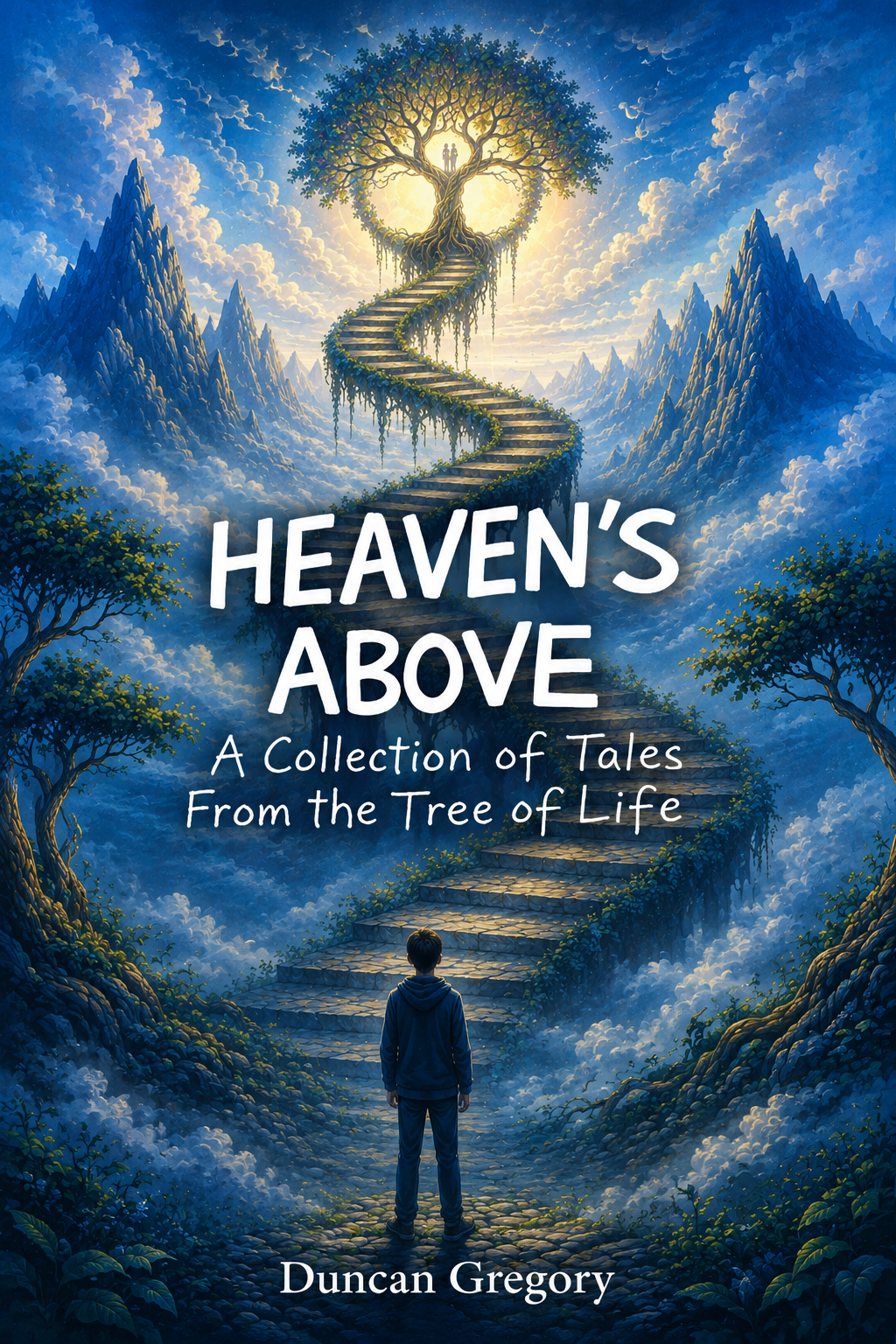
Heaven’s Above! is a gripping read: 13 short stories which at times connects to and expands on the narrative from the earlier publication Whittling our Niche: at other times they travel in alternative directions, exploring new and exhilarating horizons. Dream sequences bookend the compendium, but many of the tales in between are brought to the page as dreams of the author, carefully crafted, and given life. An intriguing blend of fact and fiction, imagination and humour, Heaven’s Above! delivers a volatile mix which stretches across the spectrum.
“Heaven’s above! How on Earth did you do that?”
This common saying alludes to the possible illusion that after the tumult of our allotted time on earth, our final resting point is somewhere above, beyond the clouds. The first tale in the collection follows that Beyond the Clouds supposition. Some will agree. Many may not.
The thirteen stories in the collection, range from down-to-earth and factual, through to off-the-wall fabrication. Some stories sit in between the two, based on fact but seriously embellished into a sort of faction concoction. The first tale – also titled Heaven’s Above! - is a dream sequence, very much in the fiction genre.
As a writer, the short story format intrigues me greatly, challenging my capabilities while at the same time opening up brilliant opportunities to wander in all directions. Those instigating thoughts which emerge from a wide variety of sources – a conversation at the bar, a dreamy download during the night, a remembered friendship, a sign on the wall – each can provide that initial stimulus, the kick-start to a gripping tale.
Wherever possible, I have tried to include a liberal quotient of humour within most stories, whether obvious and up front, or more hidden and disguised. And while a number of tales take a leap back to the past, such as Jonny Balozi negotiating his personal trials in Melbourne, during those halcyon days of the 1970s, others are set much more in the here and now. Many relate to my life as I now find it on the tropical coast of Kenya, while there are a number which stray way outside this isolated paradise.
There are some connections made between my first book (Whittling our Niche, from the Tree of Life) and this one, which readers of the earlier book may identify, while many of the tales are stand alone, and not related to the first book in any way.
HEAVEN’S ABOVE! provides a wide-ranging compendium of stories, which together deliver a degree of information and intrigue for all readers to enjoy. I am anticipating publication later in 2026, so please look out for it on the bookseller’s shelf, or from Amazon.
NB: The term Tree of Life is used for this and the previous book, as a descriptor for the manner in which each one of us carves our own miniscule splinter from Life’s Tree: an enormous sequoia, inhabited together with the other eight billion humans on Planet Earth.
Starry, starry Nights.

There I was, just last week, punching the keyboard and imbibing intermittent sips of my ice-cool Shekarato, whilst listening to the melodious and much-approved background sounds from Tony Bennet, in duet mode with Lady Gaga. That was the moment when I happened to glance up to the higher wall space – three enormous, blank magnolia-brushed squares, four or five metres above where I sat – wondering if the owner (or perhaps his in-or-out-of-house décor expert) had really thought the whole thing through.
The lower space is fantastic: gaslight-fashioned electric light balls; antique looking battery driven clocks; ten-feet tall tropical plants from China (almost indiscernible from the real article), along with mottled-white marble staircase and sumptuously feminine, leafy pink and white (albeit plastic) flower-wall, leading to the toilets. It was all very much in-keeping … and relaxing. But those upper, massive squares of vacant wall space? That was something else. It played on my mind.
It was a philosophical question, as well as a market-focused quandry. Was it better to leave those expansive blank spaces as they were: sparse and devoid of any feeling … except sparseness. Magnolia I’d always known as real estate paint: cheap, neutral and non-confrontational; designed to provide uniform background calm, and sell a house. But in a café setting could it be that such blankness gives the clientele time to sit back and contemplate in the same way: to focus and make decisions, unimpeded by clutter?
Or, would it be better to provide a thought-provoking stimulus; to fill those upper spaces with a semblance of the same intriguing décor from below, and so inspire the up-looker towards a higher plane of thought, the results of which could, for any particular wall-gazer, be either stored internally or emitted (along with all those noxious carbon gases we hear about) to share with a friend ... or the phone? And, perhaps more importantly, at least from the already very wealthy owner’s viewpoint, resulting in the need for more gastronomic delights, thus encouraging further contemplation, as is now the case for yours truly.
I beckon the nearest waitress, resplendently attired in white blouse above stretched blue denim: “Could I have another Shekarato please miss?”
Smoke Doctor
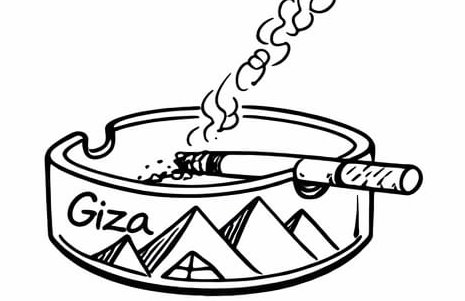
Two sparkling blue words jumped out of the dazzling neon display, up above the level of the ground floor shops; their message hit me right between the eyes: SMOKE DOCTOR! The letters were perhaps a metre high, in caps, each beside the other, playing with its opposite number, reveling in the utter joys of decadence, fornicating with its wall-mate. It was an aberration of course: a nonsensical play on words.
Next to SMOKE DOCTOR, was another equally arresting neon sign, blazing forth in red: SMOKING CITY! This one it seemed, spelt out the same ethos, in layman’s language, but I liked SMOKE DOCTOR more. To my mind, it was the slightly more subtle Egyptian cry, to STOP the modern-day rush towards everything politically, and socially correct.
SMOKE DOCTOR you could say, stood out from the pursuing pack, a single middle finger extending upwards, gesturing unapologetically towards the wider world, with SMOKING CITY right behind, pushing hard, along with a plethora of other exemplars I had so far seen during my short stay in Cairo. They all nipped at the obvious standout’s heels: the also-rans in an Olympic sprint; Mbappe and Messi trying to chase down Maradona. As light faded to dark in the nippy glow of an early Middle East evening, I was over-the-moon about that.
The next morning, just before noon, I’d been invited to enjoy a typical Egyptian breakfast. Well, let’s not elongate the morning meal time-zone too far; perhaps I should rephrase that as a typically Cairene midday, multi-plated feast, which stretched the limits of our somewhat flimsy table. It was a Saturday, the second day of the Muslim weekend, when Allah takes a back seat and you have fun. So the place was packed. Looking around, many diners I noticed were already following the smoke doctor’s endorsement, but being outside of course, that could have been the same in a plethora of other places, not just this City of Pyramids.
The food was superb. Some dishes hit my taste buds even more than others, especially the delicious breads and dips. The most intriguing aspect for me as a guy totally new to this scene, was the manner in which the food was cooked and delivered to the closely packed tables. Quite a mini-industry, which appeared to begin in a far back corner with a semi-automated dough-mixing machine, then moving forward to other branches of never-ceasing production in ovens and piping-hot pans, before being laid out on vast trays.
I wandered off to photograph and video, as many of us do nowadays with digital technology at our fingertips. Then one younger chef, like a Nubian prince with an Afro hairdo in his castle, sitting high above the rest, overseeing what appeared to be the most important part of the culinary procedures, seemed to object to my inquisitive routine, so I pocketed the handpiece and returned to our table.
“What?” Exclaimed my Egyptian host, somewhat alarmed, his dignity affronted. “No, no. He can’t do that.” My friend was a younger guy, born and bred in the surrounds. Quickly, he checked with the waiters in case there’d been some unreasoned change in accepted social policy during his recent absence in Turkiye. They concurred.
“No, he can’t object. We’re proud of our laid-back culture; proud to show it off to all our visitors. Feel free to do what you want my friend. This is Cairo.” His noncompromising edict seemed to echo and underscore that inflammatory Smoke Doctor sign I’d seen the day before.
Magic McGovern
It had been the vast expanses of Northern India which re-awakened the business-like acumen of Mungo Drew McGovern. Until that point in time, McGovern had been a mostly switched-off, rather than switched-on, entrepreneurial soul; often opting for more devious ways forward than by actually soiling his hands, or badgering his brain to any great excess.
He had arrived there more by chance than good management, although to be fair, his journey had been motivated in part by some indescribable search for enlightenment, which most likely dated back to The Beatles, Maharishi Yogi, the Concert for Bangladesh, and all that psychedelic stuff: the alternative agenda you might say. It was a distinct if rather indefinite motivation, wrapped and parcelled together back in those heady days when youth was king ... and queen. Unlike his friends of that time, he’d admired George Harrison more than the others; somehow George had seemed just that bit more subdued and sincere in his searching.
Anyway, that was a long time ago. Enlightenment had become lost in the quest for other fascinations. To be truthful, his search for illumination had wavered significantly in its forward path. Over time he’d become a believer in the maxim: ‘If you can’t change direction, you’ll end up where you’re going.’ The main problem was that he didn’t really know which path he was on, or what on earth was his destination. Perhaps that’s why he ended up in India.
McGovern gravitated through that enlightenment decade; from the mysteries of Sergeant Pepper, to the materialism of Ziggy Stardust. Bowie said it all for the sensuous seventies and Ziggy became his newfound enlightenment … until that was, the electrifying emergence of Johnny Rotten, and the dawning of pure punk. Then our man Mungo was swept away again. Johnny and Sid banging out an off-key version of God Save the Queen was indeed music to his ears. “Yeah, fuck the lot of them!”, became his catch-cry.
Until then, he’d managed to combine his Bowie devotion with a seen-to-be-fashionable clerical position in a rather seedy West End bookstore, known to all and sundry as The House of Dust. The feigned Bowie hairdo, make-up and dress, somewhat frowned upon by the establishment, were stoically tolerated as unfortunate symptoms of the grossly outlandish times. But when Mungo turned up one Monday morning decked out as a Sex Pistols look-alike, that was an altogether different matter.
The establishment’s representative – namely the weedy little balding, ex-Italian geriatric, who masqueraded as his boss - had been quite civil about the whole thing, suggesting he went back to his former, barely tolerated, if rather glam effeminate image. McGovern replied with an admirable Sid Vicious sneer, backing out of the shop with two fingers held aloft and kicking a few books off the bargains shelf in a defiant exit, which he was sure his new guitar-smashing heroes would be proud of.
“Fuck you, and your boring little bookshop Don Corleone. I’m off to get a life!”
Heaven’s Above!
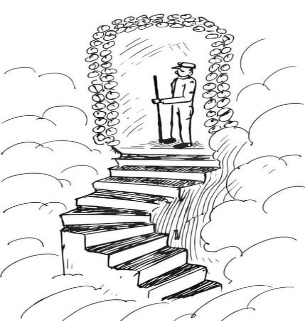
It first struck me as some gargantuan, magnificent airport control tower, but some way above and beyond anything one could imagine on Planet Earth. The desk-type stations - in a mottled shade of blue and white to match the sky beyond, each equipped with a screen - stretched as far as the eye could see, with a person engaged at every terminal. This time there was nobody around whom I recognised, but there did happen to be one vacant seat in front of the station I was standing next to. Was that pre-ordained? I wondered.
Settling myself in front of the large curved screen, and with prior information from Henry, I knew this was where I could choose who to focus on down below. It brought to mind a clip from Sir David Attenborough - speaking in that oh-so-well-known voice of his - about looking in on the feverish activities inside a termite mound, with the termites totally unaware of him looking down on them. Now, just like those tiny insects, people back on earth would be unable to comprehend that I was observing their activities from above. As he’d looked in on the termites, Sir David had postulated a theory related to the possible presence of a Devine being. Now of course, I was well able to see the truth in that theory.
So seated there, I began thinking of my youngest daughter who had been staying with me when I had departed that existence. I was afraid she may have been traumatised by the circumstances of my sudden leaving. Instantly, she was on the screen. It was extremely life-like, three-dimensional you could say, as if I was actually looking at her running around the playground, engaged in a sort of team-tag game; which in truth I was. She seemed happy enough, yelling out ‘Marco, Polo,’ trying to dodge her friends as she ran.
“Oh Malaika, I really miss you my girl, and your love for all things living. Painting those fish on my bathroom wall; untroubled by the snake in your hair at the local wildlife park; your song, Malaika, which you loved to sing so beautifully at the beachside karaoke. I remember it all my little angel as if it were yesterday. If only I could be there still, alongside you.”
I could feel tears welling up, so I switched to different thoughts altogether; thoughts of the broader troubles which had begun to impact the earth before my exit: the onrushing climate crisis and the threat of nuclear war. The subjugation, the deprivation, of billions of ordinary folk by an increasingly powerful few: the Oligarchs of the East and the storied billionaires of the West. I was anxious to know what might have happened since I’d departed the scene?
Immediately, a bit like zooming in with GPS, my screen changed to a range of disconcerting images: of horrific storms in the east - it looked like Asia, perhaps India - with people clinging to rooftops as dams burst in the Himalayas and tsunamis overran vast coastal regions. Then, in North America, which I recognised by the Grand Canyon and other well-known landmarks, it appeared almost the opposite: a coast-to-coast parched land, tinder-box dry with vast fires burning in some regions. I thanked God – since here I was, in Heaven – that Malaika was still safe in Kenya.
--------------------------------
The book will be published later in 2026, so to continue on with these four stories and all the other stories in the book, please feedback with your comments on this site, and we will notify you re. the date of publication.