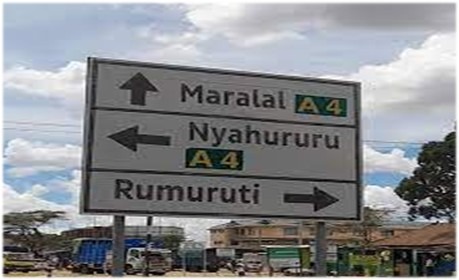
A place named Rumuruti (‘remote area’)
Illustrious Wang’ombe stood on the roof of a
clapped-out Toyota, hands cupped above eyebrows
to shield his gaze from the scorching sun. In freshly
laundered safari suit, he and his car presented a
vision in white (embellished by brown rust spots).
“I’m sure that school is around here somewhere,” he called down to me in his deep baritone voice... “Or at least it used to be.”
Our mission was to visit a small outlying primary school, prior to lunch in the local market town. After a further half-an-hour we had to admit failure, arriving late for the lunchtime appointment.
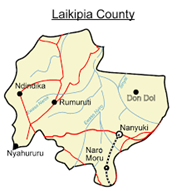
Rumuruti lay at the end of the bitumen, the start of the dirt road leading to Samburu country. We were there on a Tuesday, the busy day of the week, when Samburu tribesmen came to town to trade their cattle, sheep and goats. The sights and sounds were a glorious spectacle, as the nomads in traditional dress, some brandishing spears, haggled over prices, while traders did business on food and drinks.
We had arranged to meet James, the local doctor, and Evans, a youth group leader, for nyama choma (roast meat) luncheon. ‘Why bother with fire?’ I asked myself. ‘The meat could have been roasted on the hot tin roof which shielded us from the sun’s glare!’ I felt a cool garden salad would have been more appropriate, but meat was the much-preferred tradition in these parts.
Later that afternoon we found Evans and his youth group members at the local community hall; together they demonstrated their latest street theatre production, highlighting crucial issues that locals had to deal with. There was an equal number of males and females, who impressed with their sheer vitality. They knew the challenges for those living in poverty; their task was to help people tackle them.
Returning to the town a few weeks later, I was stunned to hear the youth group had lost its leader. During the short time I was away, Evans had died of malaria, despite efforts by James to save him. It made me think about the value of life. At about the same age as Evans, I had escaped cancer, through surgery in a good hospital. If the youth leader could have availed similar medical attention, he would probably have dodged the jaws of death.
Returning to the town a few weeks later, I was stunned to hear the youth group had lost its leader. During the short time I was away, Evans had died of malaria, despite efforts by James to save him. It made me think about the value of life. At about the same age as Evans, I had escaped cancer, through surgery in a good hospital. If the youth leader could have availed similar medical attention, he would probably have dodged the jaws of death.
After that second sobering visit, Illustrious and I did manage to find the school which had gone AWL first time around. Coming away from the school, I asked him what people were doing walking with heavy-looking sacks over their shoulders. “They’ve discovered a dead elephant,” he told me. “That meat will keep their families going for some time.”
Eating recently deceased elephants; roast meat in the hot sun; succumbing to malaria, and three kids before seventeen. The cultural gulf was suddenly enormous!
- A COMMENT FORM THE AUTHOR:
I had some wonderful times with Illustrious at the helm, introducing me to Community Kenya. This particular journey to Rumuruti caused me to write a poem related to the underlying issues which govern the people I met there. The poem - I went to a Village – can be found in the POETRY section, under the ‘INTO AFRICA’ chapter.
Duncan Gregory