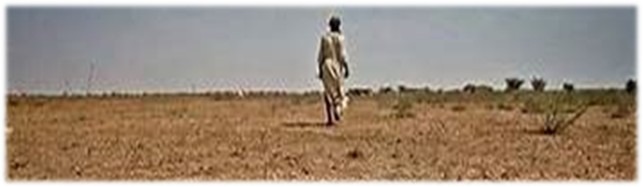
So, do we blame ourselves for the climate crisis ... or is God the culprit?

Kenya is a nation of churchgoers, supported by a raft of religious rituals. Christians, Muslims and Hindus alike assemble for regular and often lengthy worship; prayers are offered up before and after every public meeting; and prior to the start of a cross-country safari, one’s God is called upon to bless the journey (necessitated by the inordinate death toll on the country’s roads).
So, it comes as no surprise to hear a female pastoralist from the arid lands of North-
East Kenya, decrying the combined wisdom of the world’s scientists, after being told that
climate change is man-made:
“How can man change the climate and make it stop raining. It is God’s will that has brought the drought.”
Regardless of this absolute trust in the power of The Almighty, Kenya’s environment and its related economy is being negatively affected by climate change. The country’s rivers that flow from the towering central massif, Mount Kenya, are slowly drying, its more remote pastoralist areas that stretch across the north of the country are turning to desert, and the food chain from land, to animals, to humans, is breaking down. The ramifications of the rural drought stretch to the streets of the capital, Nairobi, where millions face daily power rationing, severe water shortages and higher food prices.
In battle terminology, the equatorial countries (of which Kenya is one) are on the front line; these countries which form a belt around our planet are the world’s forward troops, staring down their gun barrels at the advancing forces of climate change! And the worst of this scenario is that the oncoming forces are hell-bent on laying our equatorial areas to waste. The climate crisis is advancing in a pincer formation, first attacking through the polar and equatorial regions, then later, squeezing the temperate belt in between into submission. The onslaught of climate change for Europe’s Rhine lands and the mid-west corn fields of the USA, is a lady (largely) in waiting: a fate yet to come (the current and regular extreme heat waves already proving to be an excellent indicator).
But back to the immediate frontline threat on the equator. To deal with this known global phenomenon, Kenya’s wananchi (along with its government) need to fully understand the intricate complex of challenges they are up against. As well as the overall planetary concerns of ongoing fossil fuel use and excessive carbon emissions, there are local obstacles to consider, including a range of home-grown causal factors, such as an ever-increasing population and insufficient investments in rural infrastructure and land management. In addition, for Kenya, an endemic situation of graft and corruption (at all levels) is a related complication that makes it even more difficult to adapt to climate change and stave off impending disaster.
For the future of Kenya, it is vital that practical solutions are found to meet concerns of the society and help build sustainable systems, less vulnerable to increasingly unpredictable weather patterns. Importantly, it is up to the youth of Kenya to take up the fight to address climate change and inspire a new generation to succeed where their elders have failed (and are still failing); to inspire new ways of thinking, to adapt to new methods, and to act in unison.
Kenya’s very young population (50% in the 0-15 age group) has the potential to assist. There are over 30,000 schools across the country, with more than 4,000 at secondary level, and apart from their purely academic function, many play a key role as a focal point for their surrounding communities. Secondary schools, in particular, are well placed to act as catalysts for community action, and those youths fortunate to attend these schools – the country’s future leaders – can have the knowledge and abilities to become change-makers: young people able to motivate others to develop a better understanding on the causes and impacts of climate change and environmental degradation. This could contribute greatly to providing a foundation for greater understanding and a conduit for widespread action at both local and national levels.
Climate change is here and now in Kenya, already seriously affecting the well-being of millions of people. It is a salutary warning for the more so-called advanced (and affluent) nations, that a problem which in essence they have created, through industrialsation driven by fossil fuels, will in time rebound to impact on their own livelihoods. Climate change is a global issue, transcending national boundaries, but impacting first on those who can least afford to cope with the consequences.
The ‘God, not man’ cry from the lady in Kenya’s far north, verbalises a common dilemma related to understanding the underlying causes. In addition, it underscores the incapability of people in such situations to deal with the crisis that has impacted so severely on their communities. They require an integrated system of education, action and infrastructure, which involves youth at its core, to help them deal with the situation.
As the late Wangari Maathai (Kenya’s 2004 Nobel Peace Laureate) noted:
“Climate change will bring massive ecological and economic challenges … alleviating dehumanizing poverty will become even more difficult.”
One of the keys to enabling understanding and adaptation is to harness the power and ingenuity of youth. As Kefa Kones Kibet, a 17-year-old from a secondary school in Kenya’s Rift Valley, remarked:
“Climate change causes suffering for people. Many people in Africa walk for miles in search of water. Women are the ones who suffer most because they are the ones who look out for the family. People should be educated on how to plant trees and how best to use the little water available. The only way to curb climate change is for local action now, to create a better tomorrow.”
A COMMENT FROM THE AUTHOR: This piece was adapted in 2025, from an article
I first wrote in 2009 (at the height of a severe drought in Kenya). It was published
by the BBC later that same year. So now, a decade and an half later, it concerns me
greatly, that nowhere near enough action has been taken to rectify the increasingly
grave situation, as the Climate Crisis marches ever onward!
Duncan Gregory